
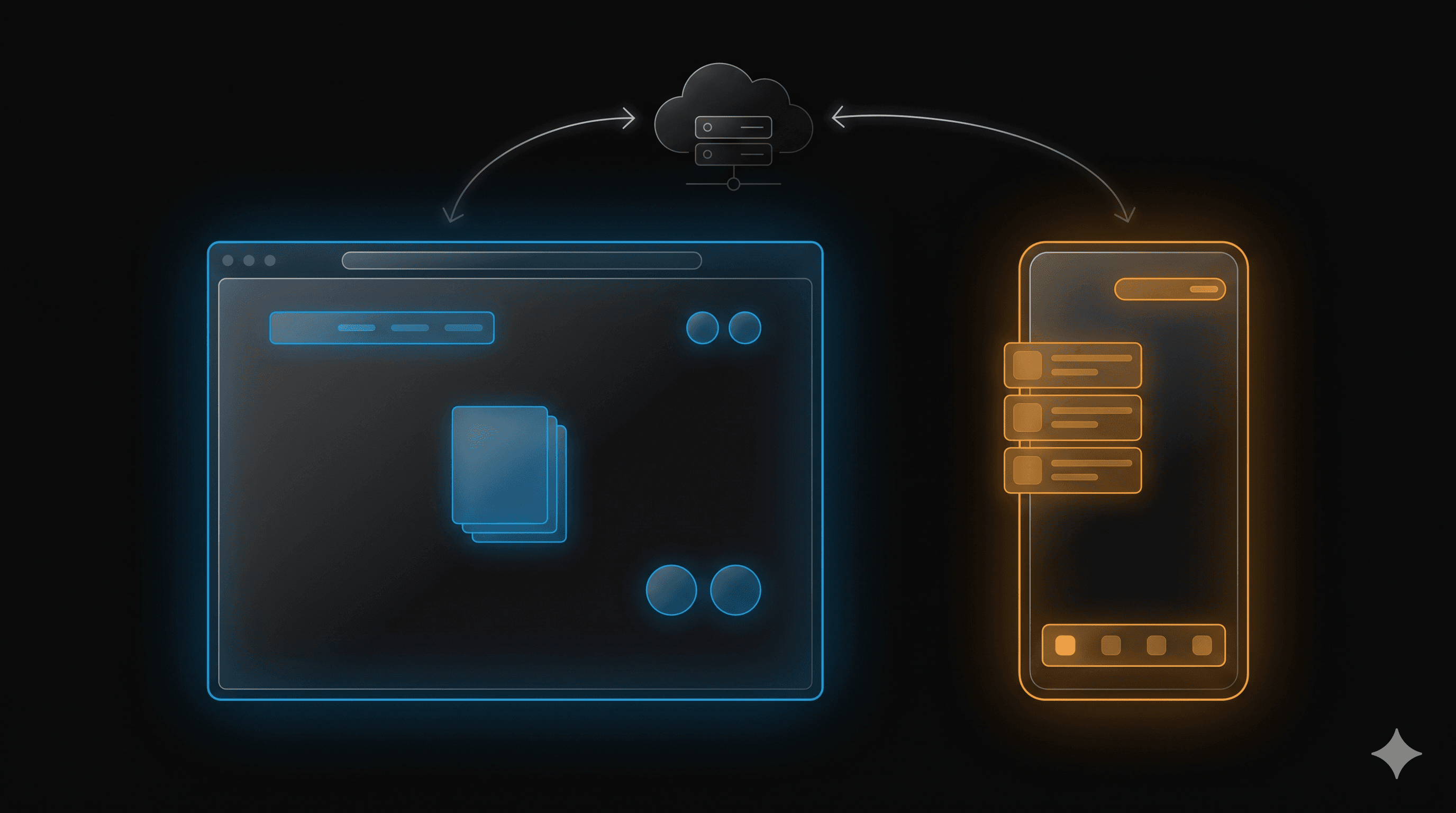
the question every startup faces
you have a product idea. you have a budget. and you need to decide: web app, mobile app, or both?
this decision shapes your entire product roadmap, so getting it wrong early costs more than just the initial development budget. it affects your go-to-market speed, user acquisition strategy, and engineering costs for the next 12 to 18 months.
here's how to think about it clearly.
web apps: the pragmatic choice
a web app runs in the browser. no app store. no downloads. users access it through a URL on any device.
build a web app first when:
- your users work on desktop. B2B tools, dashboards, admin panels, content platforms. if the primary use case involves a keyboard and a larger screen, web is the obvious choice.
- SEO matters. web apps can be indexed by search engines. if organic discovery is part of your growth strategy, you need a web presence.
- you want the fastest path to market. one codebase serves all platforms. no app store review process. deploy updates instantly.
- your budget is limited. web development is typically 30 to 40 percent cheaper than building native mobile apps for both iOS and Android.
the tech: we build web apps with Next.js and React. server-side rendering means fast load times and SEO visibility. TypeScript catches bugs before they reach users. the same codebase works on desktop and mobile browsers.
mobile apps: the engagement choice
a mobile app lives on the user's phone. it's always one tap away. it can access native features that web apps cannot.
build a mobile app first when:
- your product needs native hardware. camera, GPS, accelerometer, Bluetooth, NFC. if the core experience depends on phone-native capabilities, you need a mobile app.
- push notifications drive your product. yes, web push exists, but mobile push notifications have significantly higher engagement rates.
- offline access is critical. mobile apps can cache data and work without internet. web apps need a connection (PWAs help, but native offline is more reliable).
- your users expect an app store presence. some markets and demographics expect to find products in the App Store or Google Play. if your competitors are there, you should be too.
the tech: we build mobile apps with React Native. one codebase, native performance, deploys to both iOS and Android. shared business logic with the web app means less duplication if you later build both.
the cost comparison
| factor | web app | mobile app (cross-platform) | both |
|---|---|---|---|
| development cost | $10,000 to $40,000 | $15,000 to $50,000 | $20,000 to $70,000 |
| time to market | 2 to 4 months | 3 to 5 months | 4 to 7 months |
| ongoing maintenance | lower | higher (OS updates, store reviews) | highest |
| user acquisition | SEO, ads, direct links | app store, ads | all channels |
| update deployment | instant | app store review (1 to 3 days) | mixed |
with React Native for mobile and Next.js for web, a significant portion of the business logic can be shared between platforms. this makes "both" cheaper than building two completely separate apps.
the hybrid strategy most startups should follow
for most startups, the smartest approach is:
phase 1: design sprint (30 days) design the product for both web and mobile. the user flows, information architecture, and UI are designed together so the experience is consistent across platforms. this costs the same whether you build one platform or both.
phase 2: build the web app first (2 to 4 months) launch the web app. start getting users. collect feedback. iterate on the experience. the web app serves as your production prototype.
phase 3: build the mobile app (2 to 3 months) with validated UX from the web app, the mobile app development is faster and more certain. you already know what works. the mobile app inherits the proven design and adds native capabilities.
this approach reduces risk. if the product concept doesn't work, you've invested less before learning that. if it does work, the mobile app builds on proven foundations.
when to build both at the same time
there are cases where building both simultaneously makes sense:
- your product requires both. a delivery app needs a driver mobile app and a restaurant web dashboard. building one without the other doesn't work.
- your funding supports it. if you have the budget and the team to build both without cutting corners, parallel development is faster to market.
- your competition requires it. if every competitor has both web and mobile, launching with only one puts you at a disadvantage.
common mistakes
mistake 1: building a mobile app because "everyone uses phones." mobile traffic is high for social media and entertainment. but for B2B products, productivity tools, and content platforms, most users prefer desktop. check where your specific users are, not the general statistics.
mistake 2: building a responsive website and calling it a mobile strategy. a responsive website is not a mobile app. it doesn't have push notifications, offline access, or native performance. responsive design is table stakes for any web product, not a substitute for a mobile app.
mistake 3: building native iOS and Android apps separately. unless you have a specific technical reason (heavy graphics, AR/VR, low-level hardware access), building two separate native codebases doubles your development and maintenance cost. cross-platform frameworks like React Native deliver native performance with a single codebase.
the bottom line
start with the platform your users need most. for most B2B and SaaS startups, that's a web app. for consumer products that rely on phone-native features, that's a mobile app. for most products, web first and mobile second is the lowest-risk path.
whatever you choose, design for both platforms upfront. the UX work costs the same, and it means you can add the second platform without redesigning the product from scratch.
if you're deciding between web and mobile, book a discovery call. we'll look at your users, your market, and your budget, and give you a clear recommendation.