
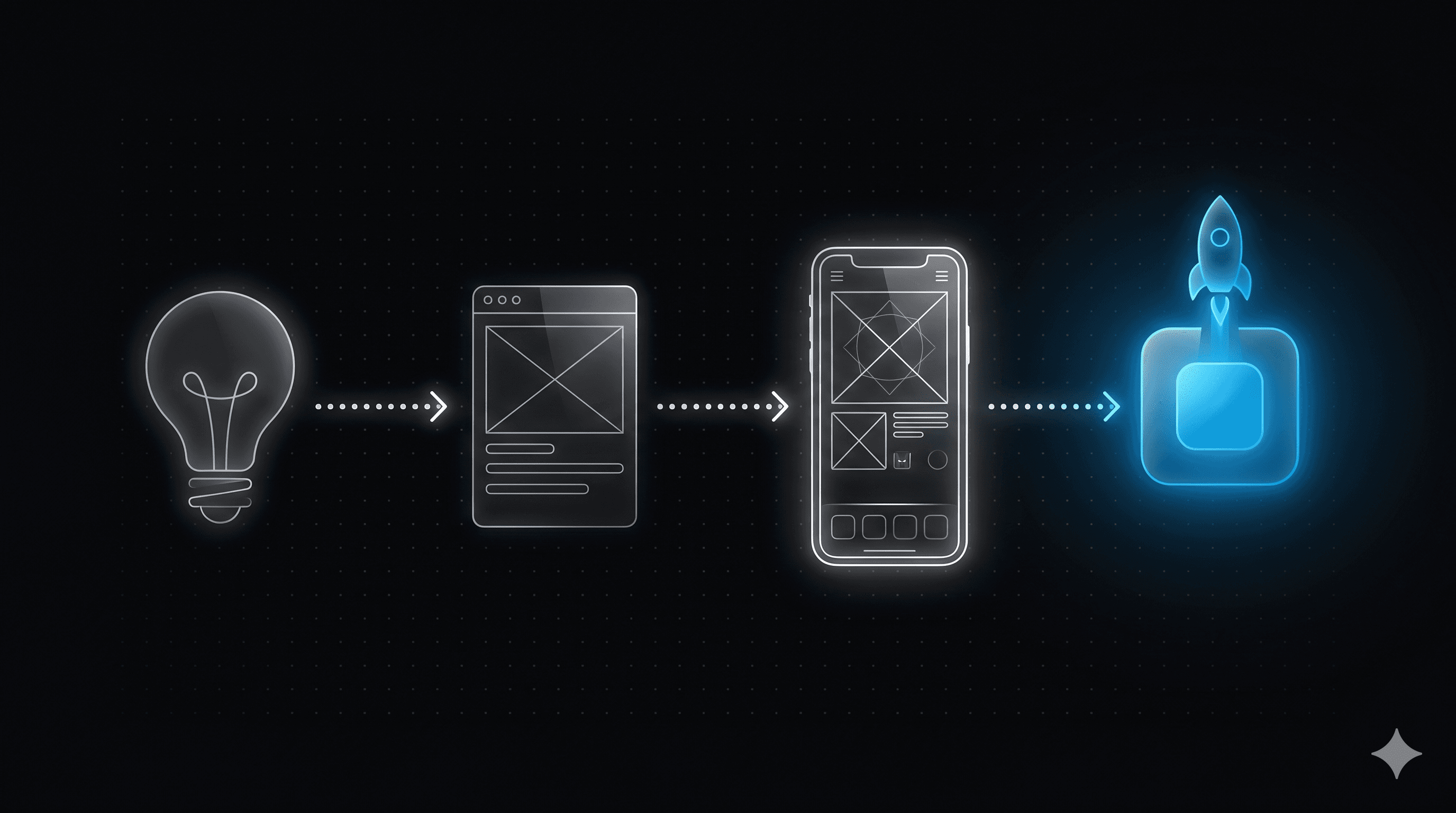
the question every founder asks
"how do I build my app?"
it's the first question we hear in almost every discovery call. a founder has an idea, maybe a pitch deck, sometimes a rough sketch on a napkin. they want to know: what does it take to turn this into a real product?
the honest answer is that building the app is the easy part. the hard part is building the right app. and most founders skip straight to development without doing the work that determines whether the product will succeed.
the mistake that costs $50,000 or more
here's the pattern we've seen play out dozens of times across Lebanon, Dubai, and the wider GCC:
- founder has an idea
- founder hires developers (or an agency that starts coding immediately)
- three to six months later, a product exists
- users try it and get confused
- the product gets rebuilt
that rebuild is where the real cost lives. not just the money, but the time, the team morale, and the missed market window.
the fix is simple in concept: validate before you build. but most founders don't know what that looks like in practice.
the process that works
at maxiphy, every app development project follows this structure. whether it's a web app, mobile app, or SaaS platform, the steps are the same.
step 1: define the problem, not the solution
before any design or development starts, we need to answer three questions:
- who is the user?
- what problem are they trying to solve?
- why will they choose your solution over the alternatives?
most founders start with a solution ("I want an app that does X"). we start with the problem. the solution changes as you learn more about the user. the problem stays constant.
step 2: map every user flow
once the problem is clear, we map every action the user will take. every screen, every decision point, every edge case. this is the information architecture phase, and it determines the entire structure of the app.
a login screen seems simple until you account for: first-time users, returning users, forgotten passwords, social logins, two-factor authentication, error states, loading states, and empty states. every screen has this kind of depth.
mapping flows before development means your engineers know exactly what to build. no ambiguity, no guesswork, no "I assumed it worked like this."
step 3: design and validate
with flows mapped, we design high-fidelity screens and build an interactive prototype. this prototype looks and feels like the real app, but it's clickable Figma, not code.
we test this prototype with real users. they try to complete tasks. we watch where they get stuck. we fix the design. we test again.
by the time development starts, the product has already been validated. the design is proven. the flows are tested. the engineering team is building from certainty, not assumptions.
a validated prototype typically saves 2 to 4 months of engineering time. at any reasonable development rate, the ROI on pre-development design is significant.
step 4: build with the right stack
with a validated design in hand, development becomes a translation exercise. we build web apps with Next.js and React, mobile apps with React Native (cross-platform iOS and Android), and backends with NestJS and PostgreSQL.
the tech stack matters less than most founders think. what matters is that the code is clean, maintainable, and built to scale. a well-designed product on a solid tech stack will outperform a poorly designed product on the trendiest framework every time.
step 5: deploy and iterate
launch is not the end. it's the start of the feedback loop. real user data tells you what's working and what isn't. the first version is never perfect, but if the design was validated before development, the first version is usually close.
web app vs. mobile app: which to build first
this is the second most common question. the answer depends on your users:
build a web app first if:
- your users will primarily access the product on desktop
- you want the fastest path to market
- you need SEO visibility
- your budget is limited (one codebase, all platforms)
build a mobile app first if:
- your product relies on phone-native features (camera, GPS, push notifications)
- your users expect an app store presence
- offline functionality is critical
build both if:
- you have the budget and the user base demands it
- the web app and mobile app serve different use cases
most startups should build a web app first and add mobile later. it's faster, cheaper, and easier to iterate on.
how much does it cost?
cost depends on complexity:
| product type | typical range | timeline |
|---|---|---|
| simple web app (5-10 screens) | $5,000 to $15,000 | 2 to 3 months |
| medium web app (15-30 screens) | $15,000 to $40,000 | 3 to 5 months |
| mobile app (iOS + Android) | $15,000 to $50,000 | 3 to 6 months |
| SaaS platform | $30,000 to $100,000+ | 4 to 8 months |
these ranges include design and development. the design sprint (30 days) is always the first phase. development follows.
what makes an app development agency worth hiring?
look for these things:
- they start with design, not code. any agency that jumps straight to development is optimizing for their timeline, not your product.
- they show you a clear process. sprints, phases, deliverables, review points. if the process is vague, the outcome will be too.
- they've built products similar to yours. ask for case studies. look at the results.
- they own the full stack. design and development under one roof means fewer handoff gaps.
- they're transparent about cost and timeline. vague estimates mean scope will creep.
the bottom line
building an app is not the hard part. building the right app is. the founders who invest in understanding their users, validating their design, and choosing the right development partner end up spending less, launching faster, and building products that people actually use.
if you're at the stage where you're thinking about building an app, book a free discovery call. we'll tell you honestly whether you're ready to build, and what the right first step is for your specific situation.