
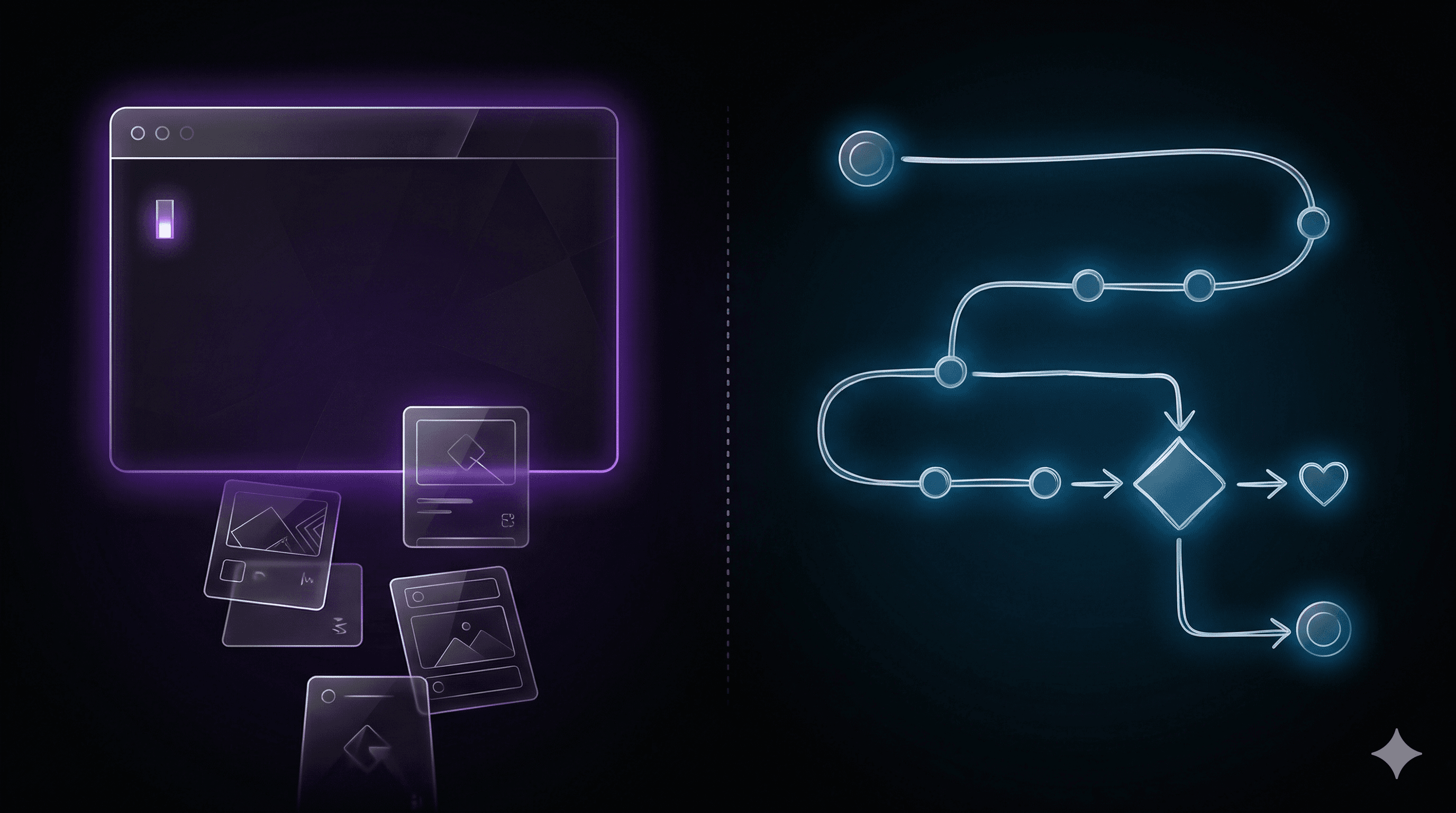
the pitch sounds incredible
"build a full app in an afternoon." "ship your MVP this weekend." "no designer needed."
every week, a new AI tool promises to eliminate the need for designers and developers. and honestly? the demos are impressive. you describe what you want, and something that looks like a product appears on screen.
but here's the question nobody is asking: how do you know what to describe?
the generation problem vs. the definition problem
AI tools solve the generation problem. given a clear spec, they can produce a UI faster than any human. that's real. that's valuable. that's not going away.
but startups don't fail because they couldn't generate a UI fast enough. they fail because they built the wrong thing. they fail because nobody mapped the user journey before opening a code editor. they fail because the founder's mental model of the product was different from the user's mental model, and nobody caught it until after launch.
this is the definition problem. and AI doesn't solve it. not even close.
AI tools are accelerators. they make you go faster. but if you're going in the wrong direction, going faster just means you waste money faster.
what AI-generated products actually look like
we've seen dozens of startups walk through our door in the last year holding products built with AI tools. the pattern is consistent:
they look polished. the colors work. the components are clean. the layout follows modern conventions. from a screenshot, you'd think the product was designed by a senior designer.
they don't work as products. the onboarding flow assumes the user already understands the product. the navigation structure doesn't match how people think about the problem. critical edge cases are missing entirely. the most important user journey is buried 4 clicks deep.
the gap between "looks good" and "works well" is exactly where UX design lives. and it's the gap that AI tools cannot see.
why the gap exists
AI generates based on patterns it has seen. it produces UIs that look like other UIs. but your product isn't other products. your users aren't generic users. your specific market context, your specific user pain points, your specific business constraints: these are the inputs that shape good design.
a designer doesn't just make things pretty. a designer asks:
- who is the user? what are they trying to do? what do they already know?
- what is the most critical path through this product? what happens when it breaks?
- which features matter at launch vs. which can wait 6 months?
- how does this flow connect to revenue? to retention? to the metric that matters?
no AI tool is doing this. and if you skip these questions, the prettiest UI in the world won't save your product.
the real role of AI in product development
here's where it gets interesting. AI doesn't replace design. it changes the workflow.
at maxiphy, we use AI tools in our own process. after the sprint is done, after the user research is complete, after the flows are mapped and the prototype is tested, AI tools can accelerate the build phase significantly. a developer working with cursor or copilot can implement a well-designed, well-specified product 2x faster than without.
the key phrase is "well-designed, well-specified."
AI makes the translation from design to code faster. it does not make the translation from idea to design faster. that part still requires human judgment, user empathy, and the willingness to ask hard questions about what the product should actually do.
the startups getting the most value from AI are the ones who design first and generate second. they use AI as an accelerator, not a replacement for thinking.
the founder's trap
the most dangerous version of this is what we call the founder's trap. a technical founder with access to AI tools can now build something that looks real in a weekend. they show it to friends. friends say it looks great. the founder assumes the product works.
six months later, they're in a loop. users sign up but don't come back. the retention curve is flat. the founder adds features. the product gets more complex. the features don't help. they add more.
this is the infinite build cycle. and it starts because nobody did the work to define what "done" looks like before building began.
the sprint exists to prevent this. 30 days of structured work that answers the question: what should this product actually be?
what to do if you're building with AI
if you're using cursor, v0, bolt, or any AI tool to build your product, here's the honest advice:
- do the UX work first. even a 2-week focused effort on user research, flow mapping, and wireframing will save you months of rework.
- don't trust screenshots. a product that looks right and a product that works right are different things. test with real users before you ship.
- separate the build from the definition. AI is great at building. humans are better at deciding what to build. use each where they're strongest.
- if you've already built something and it's not working, the fix is probably not more features. it's stepping back and understanding why users aren't doing what you expected.
the tools have changed. the principles haven't. understand the user. define the product. then build it, as fast as you can.