
the pitch sounds great
you post a job. within hours, you have 30 applications. a developer in Eastern Europe quotes $15/hour. a designer on Upwork shows a polished portfolio. someone on LinkedIn says they can build your entire app in 8 weeks for a fraction of what an agency quoted.
so you hire the freelancer. the first two weeks go well. communication is responsive. progress feels fast. you think: why would anyone pay agency rates when this exists?
then week three happens.
the pattern we keep seeing
at maxiphy, roughly 40% of the projects that come through our door are rescue jobs. a founder hired a freelancer or a small team, the project stalled or went sideways, and now they need someone to either finish it or start over.
the stories are remarkably similar:
the disappearing act. the freelancer was responsive for the first month. then replies got slower. then they vanished. the founder has a half-built codebase, no documentation, and no way to continue without reverse-engineering what was done.
the 90% trap. the product looks 90% done. but that last 10% (edge cases, error states, responsive design, performance, deployment) is where the real complexity lives. the freelancer quoted for the easy 90% and either can't or won't finish the hard 10%.
the quality cliff. the freelancer delivered something that works on their machine. but it breaks on mobile, has no loading states, doesn't handle errors, and the code is so tangled that adding a feature takes longer than building from scratch.
the scope explosion. the freelancer said yes to everything in the initial call. halfway through, "that's out of scope" becomes their default response. the product that was supposed to cost $5,000 is now at $12,000 and still missing core features.
this isn't about bad freelancers. there are genuinely talented independent designers and developers. the problem is structural.
the structural problem with freelancers
1. one person can't do everything well
building a product requires at minimum: product strategy, user research, information architecture, UI design, interaction design, frontend development, backend development, database design, API integrations, testing, deployment, and ongoing maintenance.
even the most talented freelancer is strong in maybe three of these. the rest gets either skipped or done at a junior level. this is why freelancer-built products often look decent on the surface but fall apart under real usage.
a UX designer who can make beautiful screens may not understand user flow mapping or information architecture. a developer who writes clean code may have no idea how to structure a product for the end user. these are different disciplines. the myth that one person can master all of them is exactly that.
the best UX designer in the world can't replace a structured product design process. individual talent doesn't compensate for missing steps.
2. no accountability structure
when a freelancer disappears, you have no recourse. there's no team lead to escalate to. no project manager to call. no company reputation at stake. the freelancer moves on to their next gig, and you're left with an incomplete product and a folder of Figma files you can't use.
an agency has a brand to protect. if a project goes wrong, there's a team behind it, a process to fall back on, and a business relationship that matters beyond this one engagement. that accountability structure is invisible when things go well, but it's everything when things go wrong.
3. no process means no predictability
experienced agencies have a defined process: discovery, design, validation, development, deployment. each phase has deliverables, review points, and criteria for moving forward.
freelancers typically have a process of: "I'll work on it and show you updates." this feels flexible and lightweight. it's actually the absence of a process. and without a process, there's no way to predict whether the project will finish on time, on budget, or at all.
4. the AI era made it worse
here's the uncomfortable reality of 2025 and 2026: AI tools have dramatically increased the supply of people who can generate code and UI. a junior developer with Cursor or Copilot can produce a working prototype in days. a designer with AI tools can generate screens that look professional.
this has flooded the freelance market with people who can start projects but can't finish them. the gap between generating a first version and shipping a production-ready product is enormous. AI tools don't handle edge cases, accessibility, performance optimization, security, or the hundred decisions that make a product actually work for real users.
the result is a race to the bottom on price. freelancers undercut each other to win projects, then discover halfway through that the work is harder than they quoted for. they either deliver something incomplete or disappear.
AI made it easy to start building products. it didn't make it easy to finish them. that gap is where most freelance projects die.
5. cheaper upfront, more expensive in total
the math that makes freelancers look affordable:
| freelancer | agency | |
|---|---|---|
| initial quote | $5,000 to $15,000 | $15,000 to $40,000 |
| what you actually pay | $8,000 to $25,000 | $15,000 to $40,000 |
| what you end up spending (total) | $20,000 to $50,000 | $15,000 to $40,000 |
the "what you end up spending" line includes: the freelancer's incomplete work, the rescue agency you hire to fix or rebuild it, the time lost (typically 3 to 6 months), and the opportunity cost of launching late.
we've seen this math play out dozens of times. the founder who tried to save money with a freelancer ends up spending more than they would have with an agency, and they launch 6 months later.
when freelancers do work
to be fair, there are legitimate cases where hiring a freelancer makes sense:
small, well-defined tasks. a single landing page. a logo refresh. a specific feature added to an existing codebase. tasks with clear scope, limited complexity, and no ongoing dependency.
supplementing an existing team. if you have a product team with a PM, a designer, and a lead developer, adding a freelance developer for extra capacity works well. the team provides the structure, the freelancer provides the hands.
personal projects and prototypes. if you're testing an idea with no commercial pressure, a freelancer can get you to a proof of concept quickly and cheaply.
the pattern: freelancers work when someone else provides the structure, the process, and the accountability. they struggle when they're expected to be the entire product team.
what an agency actually gives you
the price difference between a freelancer and an agency isn't padding or overhead. it's paying for:
a process. discovery, design, validation, development, deployment. each phase catches problems before they become expensive. a 30-day design sprint costs a fraction of rebuilding a product that was coded without design.
a team. a strategist who understands your market. a designer who understands your users. a developer who understands the design. a project manager who keeps everything moving. these roles exist because no single person can do all of them well.
accountability. a company with a reputation, a portfolio, and client relationships it wants to protect. if something goes wrong, there's a team to fix it, not a Slack DM to an offline profile.
continuity. if one team member gets sick or leaves, the project doesn't stop. the knowledge is in the process, the documentation, and the team, not in one person's head.
ownership of the outcome. an agency doesn't just deliver code. it delivers a working product. that means handling the deployment, the edge cases, the bugs, and the inevitable adjustments that come after real users start using it.
the bottom line
freelancers aren't bad. the freelance model is bad for building products.
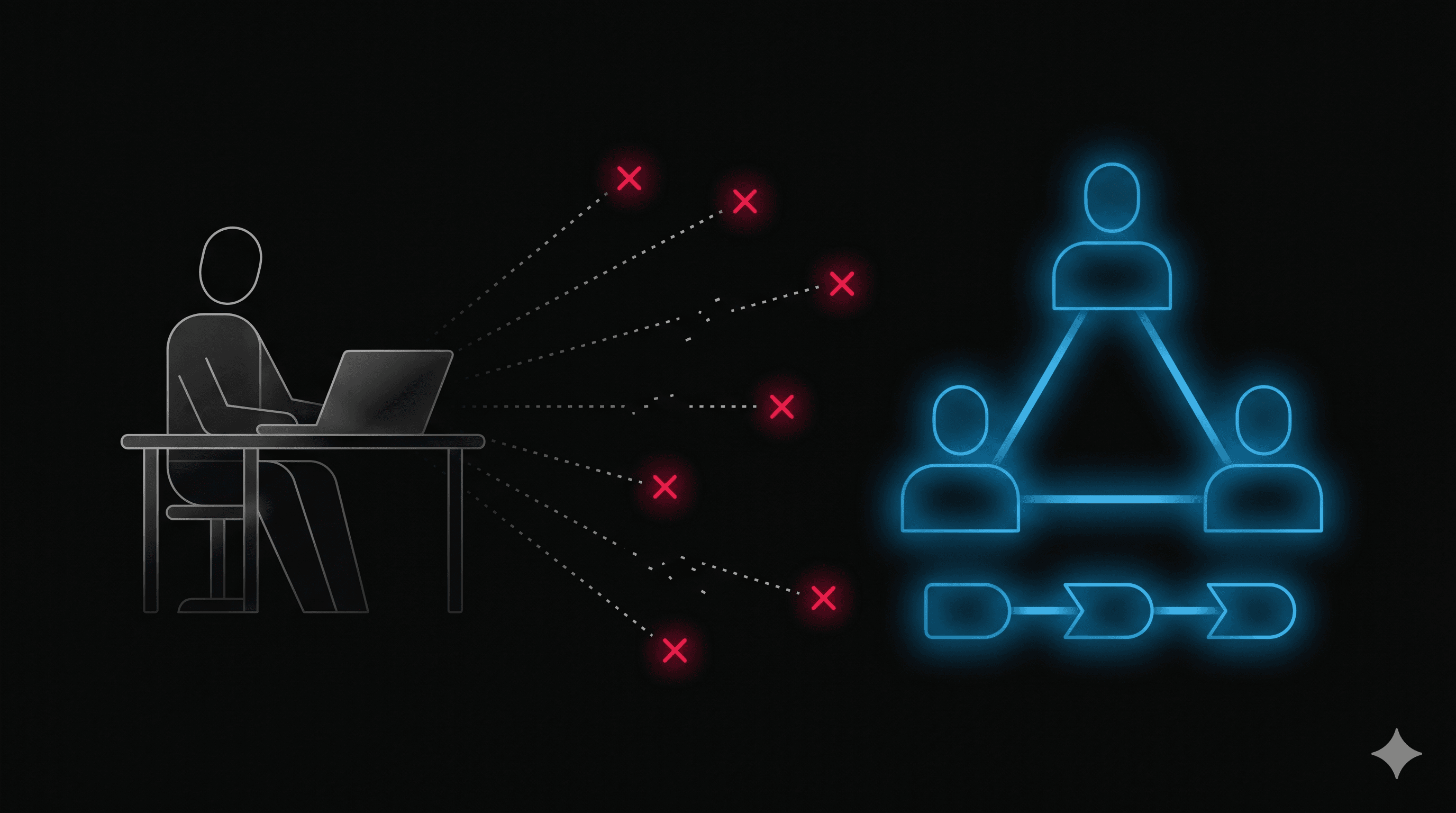
building a product requires a team, a process, and accountability. freelancers provide talent. talent alone isn't enough.
if you're a founder choosing between a freelancer and an agency, ask yourself one question: "if this person disappears tomorrow, can my project survive?" if the answer is no, you're not saving money. you're taking a bet.
if you've already been through the freelancer cycle and need help finishing what was started (or starting over with a proper process), book a discovery call. we'll look at what you have, tell you honestly what's salvageable, and give you a clear path forward.