
the problem
people write love letters that get lost. they tell stories about how they met, the moments that mattered, the people who shaped them — and none of it survives in a form worth keeping. photos sit in camera rolls. voice notes expire. the stories that define a relationship live in memory alone.
ossotna — Arabic for "our story" (قصّتنا) — was born from a simple idea: what if you could write a personal story, pair it with photos and music, and hand it to someone as a physical card they could tap and read forever?
maxiphy created ossotna from scratch — the brand, the product, the engineering. now, with 700+ stories eternalized and growing, we revamped the entire tech stack to scale into new product lines and automate the fulfillment pipeline.
what ossotna is
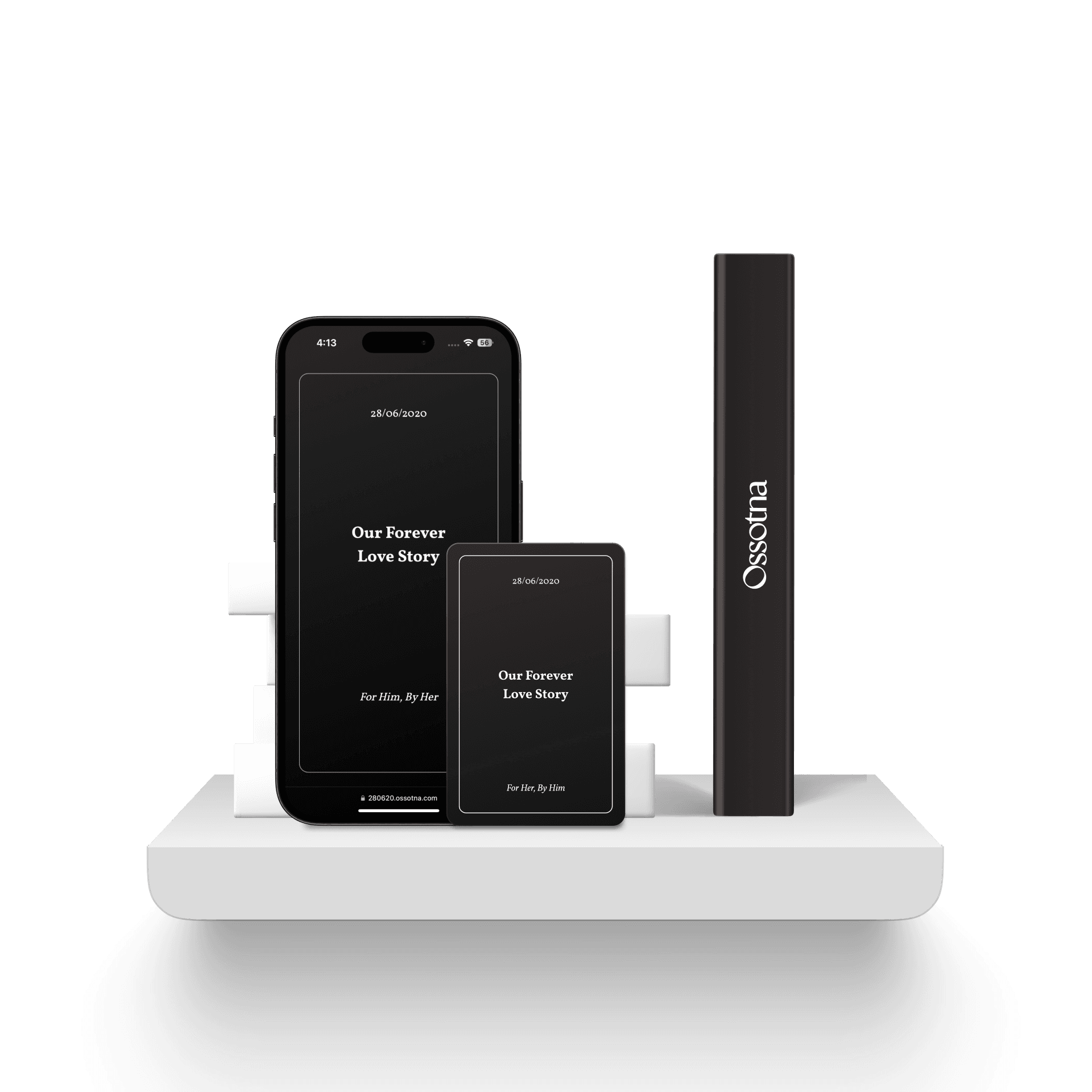
the product is a physical NFC-enabled card inside an elegant book-shaped box. the customer writes a personal story — a love story, a letter to their mother, a tribute to a friend — and that story is permanently hosted at a unique URL on ossotna.com. when someone taps the card with their phone, the story opens instantly.
chapters with text, photos, image carousels, voice notes, background music. stories in English, Arabic, French, or Spanish. public or password-protected. every detail is designed to feel permanent and intentional.
since launch, ossotna has eternalized 700+ stories across Lebanon, the Gulf, and the diaspora.
our approach
we originally created ossotna's brand, product, and first-generation systems. a 30-day UI/UX sprint defined the identity, mapped the product experience, and prototyped everything before a single line of code was written.
the brand was built to feel warm, timeless, and rooted in Lebanese culture — a refined wordmark, a color system of warm whites, deep burgundy, and golden amber, photography direction centered on emotional moments, and a packaging language for the book box, card, and transit materials.
after 700+ stories eternalized and real operational scale, we came back to revamp the entire technology layer — a new storefront, a reimagined customer portal, and an automated fulfillment center.
the key insight driving the revamp: the original systems were built for launch. with 700+ orders behind it, ossotna needed infrastructure built for scale — self-service content creation, new product lines, and automated fulfillment.
700+
stories eternalized
4
languages supported
3
systems revamped
the new website and shop
we designed and built a new storefront for ossotna.com on Shopify Hydrogen — a modern, server-rendered ecommerce experience built for speed and conversion.
the shop needed to do more than list products. it needed to communicate the emotional weight of the product while keeping the purchase flow fast and frictionless.
key design decisions:
- purchase-first, content-later — customers buy the card and write their story after. no more friction at checkout asking for intimate personal details before the product is even in hand.
- template gallery — pre-designed card options that let gift buyers purchase instantly without needing story content upfront
- live card preview — customers customizing a card can see their title, date, and cover photo rendered in real time before ordering
- bundle system — solo, unity, and dual bundles with clear pricing and upsell paths for add-on services like AI-assisted writing and custom URLs
the result is a shop that converts better because it respects the customer's comfort. buying a gift should feel easy. writing a love story should happen on their own time.
the reimagined customer portal
the biggest product leap was building a self-service customer portal — the system that lets ossotna scale into new product lines without scaling the team.
after purchasing, customers are guided through a setup wizard: choose story type, pick a language, set their URL, add a title, configure privacy, and start writing. the portal is designed mobile-first, because most customers write their stories on their phone.
the story editor is block-based and chapter-driven. paragraphs, images, carousels, voice notes — all organized into chapters that can be reordered, edited, and expanded over time. auto-save runs continuously with offline support via localStorage, so no one ever loses a paragraph.
the memories product — a new polaroid-style NFC card that links to a swipeable photo gallery with handwritten-style captions — was architecturally blocked before the portal existed. the portal's media upload flow, drag-to-reorder grid, and caption editor now make it possible to launch entirely new product types without rebuilding infrastructure.
the portal also introduced self-service story updates. customers can add new chapters for life milestones — a baby born, an anniversary, a proposal — without contacting the team. the story updates instantly.
the automated fulfillment center
we built a custom internal dashboard that automates the order-to-delivery pipeline. when an order comes in from shopify, it flows through a structured fulfillment system:
- order tracking with three-tier status: story progress, printables, and shipping
- AI-assisted story generation for customers who choose the writing assistance add-on
- image processing pipeline — upload, resize, format conversion, and cloud storage
- QR code generation with PDF export for print-ready packaging
- NFC card programming directly from the dashboard via Web NFC
- automated customer communication with templated WhatsApp messages for status updates
- delivery management from manufacturing through to confirmed delivery
the fulfillment center reduced the manual work per order significantly and gave the team a clear, structured pipeline from purchase to doorstep.
the outcome
we created ossotna from nothing — the brand, the product, the first systems — and now we've revamped the tech to match the scale the product earned. storefront, portal, and fulfillment — all rebuilt by maxiphy.
the platform now supports multiple product types, self-service content creation, and a fulfillment pipeline that can handle scale. customers across Lebanon and the diaspora are writing stories, gifting cards, and adding new chapters as their lives evolve.
the system is built to grow. new products plug into the same portal. new stories go live without manual intervention. the infrastructure is ready for whatever ossotna builds next.